

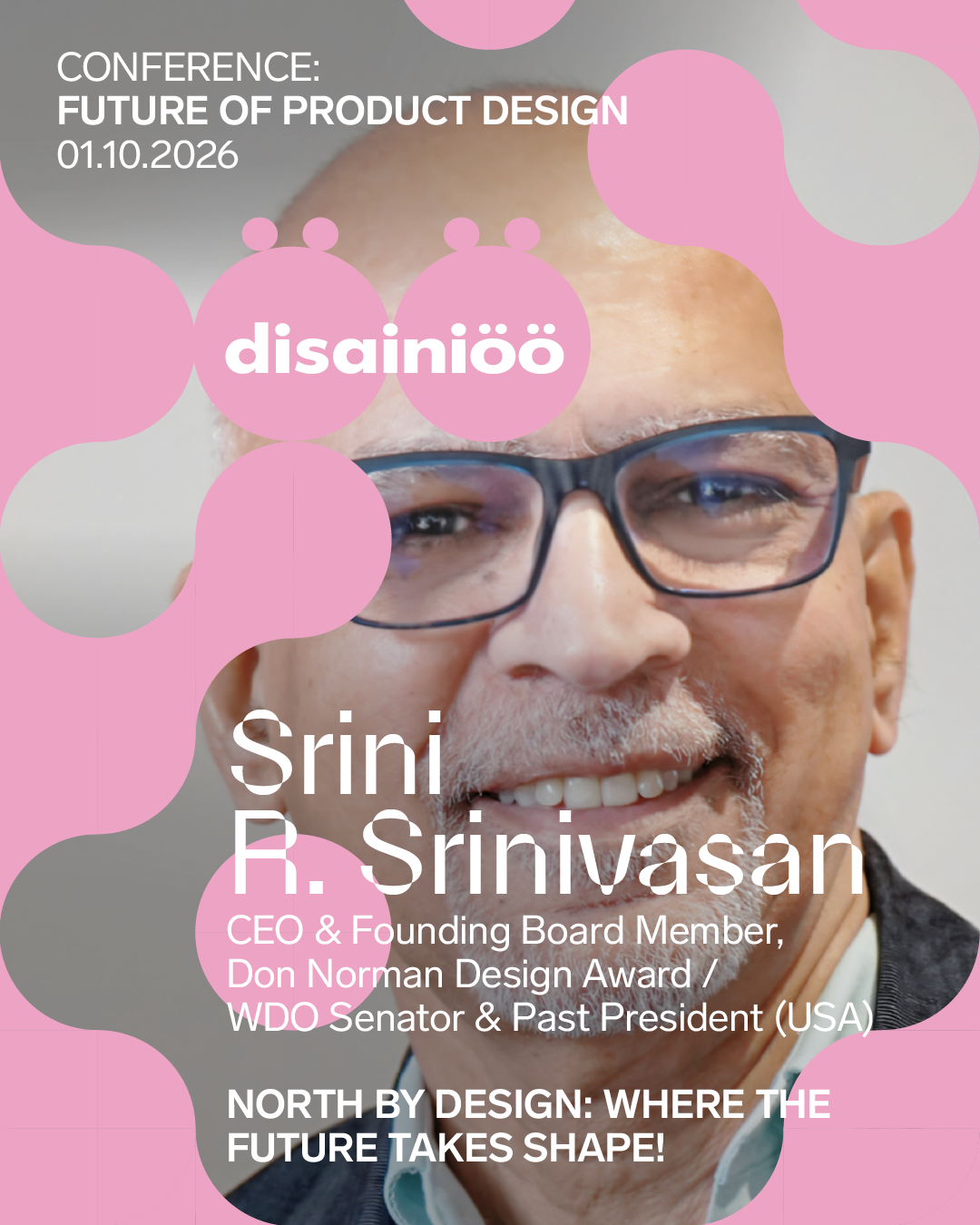
Srini R. Srinivasan: Good design starts with empathy
Ahead of Tallinn Design Festival / Disainiöö, we spoke with US design expert Srini R. Srinivasan about AI, the changing role of designers and the future of product design. His message is clear: tools may change, but good design still starts with empathy.
_____________________________________________________________
1) You’ve spent more than three decades moving between design, technology, business and education, across Silicon Valley, Europe and Asia. Looking back, was there a particular moment or project that changed the way you understood what design could actually do?
Honestly, it wasn't one product — it was the shift from designing objects to designing systems around people. Early in my Silicon Valley years I was solving for form and function; and for technology. Somewhere around my transition into WDO in 2013 and then to teaching design education I realized design's real power is in how it reframes problems before anyone reaches for a solution. These led me to co-founding Don Norman Design Award. That's when Humanity-Centered Design stopped being a phase in my process and became the lens for everything — teaching, policy, business strategy, and global well-being.
We're moving from designing things to designing intelligent relationships — products that adapt, learn, and co-evolve with the people using them. What fundamentally changes is the designer's role: less form-giver, more systems orchestrator, working alongside AI as a collaborator. The constant that won't change is that good design still starts with empathy — the tools just get faster and efficient.
3) You’ve designed hundreds of products, from consumer electronics to medical and industrial products. Is there one product or project from your career that you feel taught you more than any award ever could?
Two actually stand out — the Moka pot for a French client, and the Gemprint diamond-evaluation device for a New York client. Both were design-to-manufacture projects, and both humbled me. Despite 25+ years of experience at that time, I underestimated the manufacturing complexity on each, and paid for it in extra iterations — time and money I hadn't planned for. But that's exactly what made them so valuable. On the Moka pot, I learned things you can't get from a textbook — food-grade paint requirements, and how the type of steel actually changes the taste of the coffee. On Gemprint, I went deep into the physical properties of diamonds and the uniqueness of their internal structure. Awards tell you that you got something right. Projects like these tell you why you were wrong, and that's a far more durable kind of learning.
That the user is not a persona on a slide — they're operating inside constraints of time, money, culture, and dignity that a workshop sticky note can't capture. Designers often fall in love with the elegance of a solution before they've earned the right to propose one.
5) Estonia is small, highly digital and known for thinking differently about technology and public services. What are you curious to see or experience in Estonia’s design culture — and what do you think Estonia could contribute to the global design conversation?
I am still learning about Estonia's e-governance model, which I believe is one of the few real-world proofs that digital-first design can scale to an entire nation without losing trust — that's rare. I'm curious how a small, tightly-knit society builds design consensus so fast, and I think Estonia has a lot to teach the world about designing systems for trust, not just convenience.
Right now, more. AI has collapsed the cost of generating ideas, so volume exploded — but volume isn't discernment. Better design will come once we build the ethical and critical frameworks — the DNDA work I am doing is part of that effort — to filter AI's output through genuine human judgment rather than mistaking speed for quality.
7) You’re also a singer, golfer and even an occasional pilot. Outside the design studio, where do your best ideas tend to find you — and what does that tell you about creativity?
Usually not at the desk. Singing forces me to breathe and listen — golf forces patience and reading a system I can't control — flying forces total presence. All three strip away noise and give me tranquillity. That tells me creativity isn't manufactured under deadline pressure; it surfaces when the mind is occupied just enough to stop trying.
8) After designing so many products, what is one everyday object you still think is surprisingly badly designed?
It's less about pointing fingers at someone else's product and more a case that still nags at me — an indoor/outdoor Air Quality Monitor we designed for an Indian client. It needed to work reliably in two very different environments, and whether it was early-stage sensor technology or gaps in our own understanding of how those sensors actually behaved in the field, the readings came out inconsistent and often just wrong. We ended up completely redesigning it — at our own cost and time — because "good enough" wasn't good enough. It's a reminder that even after decades in this field, the products that look simplest — a small box that just reads the air — can hide the most stubborn engineering problems. So if you ask me what's still badly designed today, I'd say most air quality monitors on the market — because getting a small sensor to tell the truth, consistently, in changing conditions, is a much harder problem than it looks.

Meet Srini R. Srinivasan and other leading international design experts at the “Future of Product Design” conference on 1 October at Põhjala Factory, Tallinn.
The speaker line-up includes Luke Pearson (UK), Richard Hall (UK), Jean Louis Frechin (France), Ilkka Suppanen (Finland), Jaume Domenech (Germany), Hallgrim Sagen (Norway) and Siim Karro (Estonia).
1 October 2026 · 10:00–16:00
Põhjala Factory, Tallinn